How should you time selling your Thurston County home before a 2026 PCS so you don't lose money, miss your report date, or put your family under needless stress?
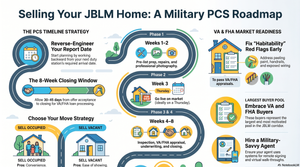
Selling 60–120 days before your 2026 PCS, aligned with JBLM report dates and local listing peaks (spring–early summer), usually gives you the best mix of price, days-on-market, and closing flexibility—if you prep and price strategically.
Why 2026 Market Timing Matters So Much for PCS Moves
PCS orders already put your timeline under a microscope. In Thurston and Pierce counties—especially around JBLM—your real estate decisions are layered on top of report date deadlines, school schedules, temporary lodging and BAH realities, and VA loan timelines and appraisal standards.
By 2026, the South Sound market will likely still be shaped by three big forces: interest rate volatility, tight local inventory near JBLM, and strong but selective buyer demand, especially for move-in ready homes.
You're not just asking, "Can I sell?" You're asking "Can I sell in time to report without paying two housing payments?" "Can I keep my VA eligibility healthy for the next purchase?" and "Should I sell or keep it as a rental?"
This guide is written specifically for military families and local homeowners in Thurston and Pierce counties who want a practical, data-minded way to time the sale of a home before a 2026 PCS—from Lacey, Olympia, Tumwater, and Yelm to DuPont, Spanaway, and Puyallup.
How the Thurston & Pierce County Market Typically Moves Through the Year
To time your 2026 sale, you first need to understand seasonal patterns around JBLM. While no one can promise exact conditions in 2026, the local cycle has been remarkably consistent over many years.
The Usual Yearly Rhythm Near JBLM
In a typical year in Thurston and Pierce counties:
January–February (Cold but important): Fewer buyers, but also fewer competing listings. Serious PCS and job-change buyers are active. Homes that are clean, priced right, and near JBLM can still sell quickly.
March–June (Peak listing and buyer season): This is historically the strongest window for pricing and activity. Families time moves around school years. Many military buyers arrive on house-hunting trips. Days-on-market usually drop; multiple offers are more common in well-priced segments.
July–August (Still strong, slightly slower): Activity stays solid, especially closer to JBLM. Some buyer fatigue shows up; pricing must be sharper. Great window if your PCS orders hit mid-to-late summer.
September–November (More selective buyers): Buyer pool shrinks but remains serious. Listings that lag from summer need price adjustments. Good for sellers who prioritize timing over absolute top dollar.
December (Slow but not dead): Showings slow dramatically. Motivated buyers—often relocations—still purchase. Not ideal for testing top-of-market pricing, but you can still complete a successful sale.
What That Means for Your 2026 PCS
Your main questions are "When should I hit the MLS?" and "How far ahead of my report date do I need to close?"
In 2026, if patterns hold, the best general listing windows around JBLM will likely be late February–April for spring PCS and school-year moves, May–early July for summer PCS report dates, and early September for late-fall PCS dates, with realistic pricing.
You don't have to hit an exact week, but listing 60–90 days before your desired move-out is usually the sweet spot. That timeframe lets you capture the broadest buyer pool, negotiate possession (rent-back or delayed closing if needed), and avoid emergency price cuts because time is running out before your orders take effect.
Reverse-Engineering Your Sale Timeline from Your PCS Orders
To protect your family, you should work backward from your report date, not forward from "whenever we feel ready." Here's how to reverse-engineer a smart 2026 sale timeline.
Step 1: Anchor Everything to Your PCS Report Date
Start with your Report No Later Than Date (RNLTD) and work backward. Ideally, your house closes 1–4 weeks before RNLTD so you have time for clearing housing, travel, and check-in without double housing pressure. Risky situations include closing within a few days of your report date or relying on buyers who also have complicating contingencies (long chains of closings).
Step 2: Account for a Realistic Contract-to-Close Period
In the South Sound, a typical financed sale (especially with VA buyers) often needs 30 days on the short end (clean file, responsive lender, no major appraisal issues) or 35–45 days more realistically, especially during peak PCS season.
This includes inspection and negotiations, appraisal and any needed repairs, loan underwriting and final approval, and clearing title and signing.
If you want to close, for example, June 15, 2026, you'd want to be under contract by roughly early–mid May.
Step 3: Estimate How Long It Will Take to Secure a Buyer
Days-on-market will vary by price point, condition and updates, neighborhood and school district, and how close you are to JBLM gates.
In a balanced to slightly seller-friendly market, a well-priced home near JBLM might get strong interest within 7–14 days and a contract within 2–3 weeks, sometimes sooner.
To be conservative, plan on 3–5 weeks from list date to mutual contract in many 2026 scenarios, faster if you price at market rather than "wish price."
Step 4: Build in PCS and Life Buffers
Once you work backward from your ideal close date, add real-world padding: 1 week for unexpected buyer delays (lender, appraisal, underwriting requests), 1 week for movers, cleaners, repairs, and final out-processing, and extra time if you have multiple kids in school, pets, or a spouse deployed or TDY.
Many JBLM families feel most comfortable listing 75–120 days before their RNLTD. This allows you to handle a contract that falls through and still recover, resolve appraisal or repair issues without panic, and decide whether to accept a lower but more certain offer versus gamble on the clock.
Timing Your Listing to Maximize Price vs. Minimize Stress
Once you know your report-date window, you can decide whether your priority is highest possible price, smoothest transition, or a balance of both.
In 2026, especially if interest rates stay somewhat elevated, pricing discipline and timing will matter more than in the frenzied 2020–2021 market.
When to Target Top-of-Market Pricing
You're more likely to push the top of the range when you can list during peak buyer months (March–June), your home is turnkey (fresh paint, clean flooring, no obvious deferred maintenance), and you're in a high-demand area like Lacey, DuPont, Yelm, and parts of Olympia close to JBLM commutes, or strong school zones buyers ask for by name.
In those cases, you might list 90–120 days before PCS, price at or slightly above recent comparable sales based on an in-depth CMA, and be firm but responsive on offers in the first 7–10 days.
When to Prioritize Speed and Certainty
You should lean toward a faster, more certain sale if your PCS report date is tight, you can't or don't want to carry the home after departure, or the home needs more work than you can realistically handle before moving.
In that scenario, it can be smarter to list earlier (even 120+ days before PCS) with clear move-out terms, price at the middle to lower end of the market-supported range, and favor offers with proven local lenders, short contingency timelines, and fewer repair demands.
Negotiating Possession So PCS and Sale Align
In Washington, it's common and legal (with properly drafted terms) to negotiate:
Rent-back (seller post-closing occupancy): You close on the home, then "rent" it back from the buyer for a short, agreed period. Useful if you need funds from closing to buy at your next duty station.
Delayed possession: You close and move out on the same day or a few days later, per contract.
Both options must be clearly outlined to comply with Washington law and fair housing standards, and they require clear daily rent amounts (if any), defined end dates, and insurance and utility responsibilities in writing.
With a good local agent and attorney-reviewed forms, these tools can bridge the gap between your best listing window and your actual PCS travel dates.
Special Considerations for VA Loans, Military Buyers, and Potential Rentals
Many JBLM-area sellers either used a VA loan to purchase or will be selling to VA buyers. That adds a few timing and strategy layers for 2026.
If You Currently Have a VA Loan on the Property
You'll want to think about restoring VA entitlement—selling and paying off the VA loan can restore entitlement for your next purchase, and timing the sale before or in sync with the new purchase can be key.
Consider the rent versus sell decision carefully. Keeping the property as a rental may limit your VA buying power at the next duty station, as lenders will look at your existing payment, projected rent, and overall DTI.
If you think you might keep the home as a rental, have a property management and cash-flow plan with realistic rent for 2026 (not wishful thinking), maintenance reserves (roof, septic, aging systems), and understanding of Washington landlord-tenant law. Run realistic numbers for vacancy, management fees, and repairs and capital expenditures. If the numbers are thin or negative, selling before PCS often provides more flexibility and less stress.
If Your Likely Buyer Will Use a VA Loan
Near JBLM, many buyers will be active-duty or veterans using VA financing. That affects appraisal expectations—VA appraisers look at both value and certain safety/condition standards. Peeling paint, broken handrails, exposed wiring, or non-functioning systems can cause delays. VA loans can close just as fast as conventional loans with good lenders, however, if the appraiser requires repairs, you need time built in to handle them.
To avoid last-minute scrambling, proactively address likely VA issues before listing such as handrails on stairs, GFCI outlets near water, smoke/CO detectors installed correctly, and major trip hazards or visible damage fixed. Build a buffer of at least a week in your contract-to-close window for any required repairs.
How All of This Affects 2026 Timing
If your PCS date is tight and you're selling a VA-financed home to a buyer who is likely VA-financed, then in 2026 you'll want to list on the earlier side of your window (90–120 days before PCS), use pre-listing inspections where appropriate to spot big repair issues early, and prefer buyers with strong local VA lenders who understand Thurston/Pierce County and JBLM timelines.
Practical 90–120 Day Countdown Example for a 2026 PCS
To make this real, imagine you have a PCS report date of August 1, 2026, a home in Lacey near JBLM, and the goal to sell, close, and move by mid-July without carrying two homes or scrambling. Here's how a smart timeline might work.
120 Days Out (Early April 2026)
Confirm PCS orders and RNLTD. Interview and select a local agent who knows JBLM, VA, and Thurston/Pierce County. Get a pricing and prep strategy based on current 2026 market data, not just last year. Schedule any needed repairs (roof, flooring, paint, exterior cleanup).
90 Days Out (Early May 2026)
Complete major cleaning and curb appeal work. Update minor items: light fixtures, hardware, landscaping, caulk/paint touch-ups. Finalize your list-price strategy based on active competition and recent sales. Take professional photos and create your listing.
75–80 Days Out (Mid-May 2026)
Go live on the MLS. Expect most of your serious showings in the first 7–14 days. Evaluate offers not just on price, but on financing type, contingency length, lender quality, and flexibility on your move-out date.
60–50 Days Out (Early–Mid June 2026)
Aim to be mutual (under contract) by this window. Complete inspection and any negotiated repairs. Get through appraisal early where possible.
With a 30–40 day contract-to-close timeline, you're now tracking to close mid–late July 2026, giving you 1–2 weeks before your August 1 report date.
If your home takes longer to go pending than expected, your early start gives you room to adjust price, accept a more conservative but guaranteed offer, and still avoid a panicked last-minute sale.
FAQ: Selling Before PCS in Thurston & Pierce County for 2026
Q: How far before my 2026 PCS should I list my home near JBLM?
Most families are safest listing 75–120 days before their report date. That window allows for days-on-market, contract-to-close, repairs, and travel without risking a forced discount or a missed RNLTD.
Q: Is spring 2026 really the best time to sell in Thurston County?
For price and activity, March–June 2026 will likely be the strongest period, especially for homes near JBLM and in popular school zones. That said, if your PCS date is later, a well-priced home can still sell quickly in summer or early fall.
Q: Should I keep my Thurston County home as a rental instead of selling when I PCS?
It depends on your finances and VA eligibility. If the property cash-flows well after realistic expenses and you're comfortable being a long-distance landlord under Washington law, holding it may make sense. If not, selling before PCS often reduces risk and restores VA entitlement for your next purchase.
Wrapping Up: Choosing the Right Timing Strategy for Your 2026 PCS
Timing your home sale before a PCS isn't about guessing the single best weekend in 2026. It's about understanding the seasonal rhythm of Thurston and Pierce County, working backward from your RNLTD, building realistic buffers for inspections, appraisals, and military life, and aligning your pricing and possession terms with your risk tolerance.
If you start your planning 3–6 months before you need to list, you'll give yourself room to choose—not just react. Whether you're moving from Lacey to North Carolina, DuPont to Texas, or Yelm to Germany, a clear timing strategy can turn a stressful PCS into a manageable transition.
Your next step is simple: look at your projected 2026 report date, count backward 75–120 days, and mark that as your ideal listing window. From there, you can build a preparation checklist and connect with a local, PCS-savvy real estate professional who can tailor this timing guide to your specific home, neighborhood, and orders.