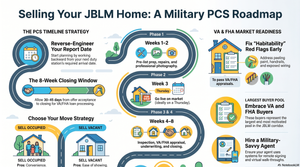
How do you price your home right in a tough JBLM market in 2026 so it sells on your PCS timeline without leaving money on the table?
Pricing your JBLM-area home right in 2026 means using hyper-local data (not Zillow), understanding VA buyer behavior, and strategically undercutting stale listings by 1–3% so you attract strong offers fast and close on your PCS schedule.
Why Pricing Your JBLM Home Right Matters More in 2026
If you're a military family in Thurston or Pierce County, you don't have the luxury of a "wait and see" approach. Orders drop, timelines are tight, and you usually need to sell your home near Joint Base Lewis-McChord on a specific schedule—not whenever the market cooperates.
In 2026, the JBLM market is tougher than what many sellers got used to during the red‑hot years. Rates, affordability, and inventory have shifted. Homes that would've sold in a weekend in 2021–2022 can now sit for weeks if they're even slightly overpriced or not positioned correctly for VA and military buyers.
You're not just selling a house—you're managing a PCS or ETS timeline, temporary lodging costs on either end, possible double housing payments, kids' school transitions in Pierce or Thurston County, and the stress of coordinating movers, travel, and closing dates.
That's why "just price it high and see what happens" is especially risky for military families. In a tougher JBLM market, correct pricing is a strategy, not a guess. When you price strategically from day one, you give yourself the best chance to attract VA and conventional buyers quickly, get strong offers with clean terms, align closing with your report date or desired move-out, and avoid painful price drops that signal weakness to buyers.
Let's walk through a 2026 pricing strategy specifically for sellers near JBLM—Lacey, Olympia, DuPont, Lakewood, Tacoma, Spanaway, Yelm, and surrounding areas—who need clarity, not guesswork.
1. Understand What "Tough JBLM Market" Really Means in 2026
A "tough market" doesn't always mean prices are crashing. Around JBLM, it usually means the market is uneven: some homes still sell fast, while others stagnate. In 2026, you're likely dealing with higher buyer sensitivity to price and condition, longer average days on market (DOM) than the boom years, and more active listings competing for the same pool of buyers.
For you as a seller, the key is not: "Is it a seller's or buyer's market?" The real question is: "What kind of home is selling fast, and how does mine compare?"
You'll want to look closely at:
Absorption rate: How many months of inventory are on the market in your specific area and price range. Example: If there are 60 similar homes on the market and only 10 are selling per month, that's 6 months of inventory—a slower, more competitive market.
List‑to‑sale price ratio: What homes are actually selling for versus their list price. If similar JBLM‑area homes are closing at 97–99% of list, you can't ignore that reality and expect 105% of your wish price.
DOM for similar properties: Not just the city, but your micro‑area and style. A DuPont 3‑bed townhome behaves differently than a 2,500 sq ft Yelm rambler with acreage or a 1960s Lakewood split-level.
In a tough market, buyers have choices. That means they will skip overpriced homes and wait, they will offer aggressively on well-priced listings, and they will notice your price reductions and assume you're desperate or the home has issues.
Your goal is to avoid becoming the "why hasn't that one sold?" listing. Pricing right up front keeps you in the "must‑see this weekend" category.
For military families, the risk isn't just a lower price; it's timing. If your home sits, you may end up paying for a vacant home plus housing at your new duty station, backing out of your next purchase, or taking a last‑minute low offer just to meet your PCS date.
Understanding the reality of the 2026 JBLM market helps you price with a clear head—not based on what your neighbor got in 2022 or what a national headline suggests.
2. Build a Hyper‑Local Pricing Baseline (Not a Zillow Guess)
Online estimates can be off by tens of thousands in the JBLM area, especially when comparing VA-heavy areas (DuPont, Lacey, Yelm, Spanaway), older established neighborhoods in Tacoma and Lakewood, or rural properties in Thurston County with wells, septics, and acreage.
To price right in 2026, you need a true comparative market analysis (CMA) that focuses on micro‑location, condition, and buyer pool, not just square footage.
Focus on the Right "Comps"
You want sales from the last 60–120 days that match your:
School district and micro‑area:
Example: A 4‑bedroom in Lacey's North Thurston School District is not directly comparable to a similar-size home in Tenino or Rochester.
General age and style (newer construction vs. 1960s vs. 1920s craftsman)
Condition level (updated kitchen and baths vs. original finishes)
Type of financing used (VA vs. FHA vs. conventional), because VA appraisals influence the perceived ceiling for similar homes.
If most of your comps closed with VA financing, that's a strong signal of your likely buyer pool and the price range an appraiser may support.
Adjust for Condition and Upgrades
Serious buyers and appraisers don't value upgrades dollar‑for‑dollar, but they do impact saleability and perceived value. Consider:
High‑value upgrades that can support the upper end of your range: New roof or HVAC, updated kitchen with solid surfaces, replaced carpet with durable LVP (especially useful for families and pets), and energy‑efficient windows and insulation.
Neutral or "you did it for you" upgrades: High‑end landscaping beyond neighborhood norm, luxury fixtures that don't match area expectations, or very personalized colors or finishes.
Your price should reflect not just the number of upgrades but whether they move your home into a different price bracket vs. similar listings.
Ashleigh Camberg often helps JBLM sellers understand which upgrades actually move the needle on price and which are simply personal preferences that won't translate to higher offers.
Use Active, Pending, and Sold Listings Differently
Sold comps: Show what the market has proven it will pay. These are your foundation.
Pending comps: Show what is working right now—these are often more important in a shifting market.
Active listings: Show your competition. If all of them are sitting for 30+ days, that tells you something about what not to do.
In a tough 2026 JBLM market, buyers shop by comparison. If your home is visibly similar but priced 3–5% higher, you're training buyers to use your home as a benchmark that makes others look like a deal.
Your baseline pricing range should be grounded in closed and pending data and then shaped by how your home stacks up against what else is available today.
3. Use a PCS‑Driven Pricing Strategy, Not a "Hope" Price
Military families can't price the same way as an owner who's in no rush and willing to test the market for six months. Your PCS or ETS timeline is a real constraint—and it should shape your pricing strategy from day one.
Start With Your Hard Dates
Work backwards from report‑by date to the next duty station, expected pack‑out and move dates, and kids' school end/start dates if you're timing around North Thurston, Bethel, Clover Park, Tacoma, or Yelm districts.
Then ask: "By when do I absolutely need this home under contract?"
If you want to close, for example, in late June, you likely need a signed offer by early to mid‑May, which means you want your strongest showing activity in April–early May, which means your pricing must be compelling from day one, not after 30 days of testing the waters.
Avoid the "Let's Try High First" Trap
Overpricing for even the first 10–14 days can hurt you because your most motivated buyers (especially those on PCS deadlines) see the listing right away. If they think, "It's overpriced; we'll wait," you've lost the best audience. By the time you reduce, many will assume you're now stale or worry there's a hidden issue.
In a tough JBLM market, a better strategy is often to price within or slightly below the realistic market value range, let buyers compete to bring the price up—or at least keep it strong, and use your leverage to negotiate better terms (inspection timelines, closing dates) that fit your PCS schedule.
Consider a "Tight" Pricing Band, Not a Wish Number
Smart 2026 strategy is to pick a price that lands in a common MLS and search portal price band (e.g., $499,900 instead of $503,000), looks like clear value against 2–3 closest competitors, and leaves a little room for negotiation, but not so much that you scare off buyers.
Example in DuPont: Comps support $515k–$530k for similar 3‑bed townhomes. Two active listings at $529k have been on for 27 and 34 days. You list at $519,900 with strong photos and prep. Result: You become the "right‑priced" option, attract serious showings immediately, and give buyers less justification to lowball.
Your pricing in 2026 should be PCS‑first, ego‑second. The goal isn't to win the neighborhood price record. The goal is to walk away with the most net proceeds while still staying aligned with your military timeline.
4. Align Price With VA Buyers, Appraisals, and Condition
Around JBLM, a large portion of your likely buyers are using VA financing. That's good news—VA buyers are often serious, well‑qualified, and motivated by their own PCS timelines. But VA lending has specific implications for pricing and condition.
Understand How VA Buyers Think About Value
VA buyers tend to be payment‑sensitive rather than strictly price‑sensitive, use BAH and PCS allowances to structure their budget, consider commute times to JBLM gates (DuPont, Lacey, Yelm, Spanaway, Tacoma) as part of value, and prefer homes that won't require major repairs flagged by a VA appraiser.
So when you price, think not just "What's my house worth?" but also: How does my monthly payment look to a VA buyer at this price point? Does my home's condition raise red flags for VA appraisal (peeling paint, missing handrails, visible roof issues, safety or habitability problems)? Is my price reasonable given what similar VA‑funded homes recently appraised for nearby?
Prepare for the Appraisal Before It's Ordered
In a tougher 2026 market, appraisals can become the chokepoint if you push your price too far over recent comparable sales. To avoid surprises:
Fix obvious repair issues early: Trip hazards, broken steps, peeling exterior paint on older homes, and loose railings or missing carbon monoxide/smoke detectors.
Document upgrades and maintenance: New roof or HVAC invoices, permits for major work, and list of system ages (roof, furnace, water heater, etc.).
A properly priced home that shows well and passes VA appraisal cleanly is far more attractive than a slightly underpriced home loaded with issues.
Use Condition to Justify Your Price Bracket
In a tough JBLM market, buyers compare photos and features ruthlessly. To support your price:
Make sure your online presentation matches your asking price. A $650k home in Lacey needs to photograph like a $650k home: clean, decluttered, good lighting, well‑maintained. If similar homes at $600k look better online, buyers question your price.
Consider pre‑listing steps that have high ROI: Fresh interior paint in neutral tones, deep cleaning and carpet cleaning or replacement, and strategic minor repairs (door hardware, caulking, outlet covers, etc.).
If you want top‑of‑market pricing in 2026, you can't ignore condition. Buyers, especially VA buyers under PCS stress, want "move‑in ready" more than ever, and they're prepared to pass on homes that look like headaches.
5. Monitor the Market Weekly and Be Willing to Adjust Early
Pricing is not a one‑time decision in a dynamic JBLM market—it's an ongoing strategy. Once your home is listed, the market will give you feedback quickly. Your job is to listen objectively.
Watch These Signals in the First 7–14 Days
Online views vs. showings:
Lots of views but very few in‑person showings = price or photos are off. Solid showings but no offers = either slightly overpriced or something about the home (layout, condition, location) is misaligned with price.
Feedback from agents and buyers:
If you repeatedly hear "nice home, but priced high for the area," believe it. If everyone mentions the same objection (road noise, small yard, dated kitchen), you may need to adjust price to account for it.
How your listing compares to new competition:
If new listings come on in your neighborhood at lower prices with better condition, your relative value just changed.
Make Price Adjustments Strategically, Not Reactively
In a tougher 2026 JBLM market, the worst‑case scenario is a long, drawn‑out series of tiny reductions. It signals desperation, weak negotiating position, and possible hidden issues.
Instead, if you've had 10–15 solid showings in two weeks and no offers, consider a meaningful adjustment into the next search band (for example, from $515k to $499,900) and pairing the reduction with a visual refresh of the listing (new lead photo, improved description, updated staging).
Align your changes with your PCS timeline. If you're 60 days from your ideal closing date and still no offers, waiting "just to see" might cost you more in carrying costs and stress than adjusting now.
Remember: Net Proceeds Matter More Than List Price
It's easy to get attached to a number in your head, especially if neighbors bragged about what they got in 2021. But in 2026, focus on your net after mortgage payoff, closing costs, and any agreed‑upon concessions, as well as your time and stress savings: avoiding months of double payments, not scrambling last‑minute while in transit, and being able to confidently move forward with your next purchase.
The right price is the one that gets you solid net proceeds on the schedule your military life requires—not the highest guess you can float on Zillow.
FAQ: JBLM Home Pricing Questions Military Families Ask
Should I price my JBLM home higher to "leave room to negotiate"?
In a tougher 2026 market, over‑padding your list price usually backfires. Most buyers, especially VA buyers on PCS schedules, won't even tour homes they see as clearly overpriced. A better approach is to price close to realistic value so you attract more serious buyers, then negotiate from a position of strength. If you overshoot by 5–10%, you're far more likely to get no offers than higher offers.
How do VA appraisals impact how high I can price my house?
VA appraisers must support the contract price with recent comparable sales. If your price is significantly higher than what similar nearby homes have sold for, you risk a low appraisal, which can force price reductions or kill the deal if you and the buyer can't bridge the gap. That's why looking closely at recent VA‑funded sales in your area is crucial when setting your price in 2026.
Can I wait to list my home until just before my PCS date?
You can, but it increases your risk. In a slower JBLM market, it's common to see longer days on market, especially for homes that aren't priced sharply. If you wait too long, you may end up carrying two housing payments or scrambling to accept a lower last‑minute offer. Many military families choose to list 60–90 days before their ideal closing so they can price competitively, adjust if needed, and still protect their timeline.
Pricing Smart So Your Move Stays on Track
In a tough 2026 JBLM market, pricing your home right is less about guessing a high number and more about reading the local data, knowing your buyer pool, and respecting your PCS timeline. When you ground your price in hyper‑local comps and current competition, align with VA buyer expectations and appraisal realities, treat price as a PCS strategy (not a wish), and watch early feedback and adjust decisively, you give yourself the best shot at selling on time and with strong net proceeds—without feeling forced into last‑minute, stressful decisions.
As you plan your move to or from JBLM, treat your pricing strategy like any mission: gather intel, use the right tools, and work with people who understand the terrain. That way, your home sale supports your next chapter instead of complicating it.
Work With PCS Home Group's Pricing Experts
At PCS Home Group, we help JBLM sellers price strategically—not emotionally—every single day. Our team brings:
Ashleigh Camberg's strategic leadership: PCS timeline coordination and realistic pricing aligned with your goals
James Camberg's market analysis: Hyperlocal comp data and trend interpretation
Kelly Barron's neighborhood intelligence: Micro-market expertise across Thurston/Pierce
We've helped hundreds of military families price and sell homes on time, at strong prices, without gambling on perfect market conditions that may never arrive.
Ready to discuss pricing your JBLM home for 2026?
Contact Ashleigh Camberg:
Phone: (360) 513-9034
Email: acamberg@pcshomegroup.com
Visit: pcshomegroup.com
Meet the team: pcshomegroup.com/team-page
Ashleigh Camberg
Military Spouse | REALTOR® | Owner, PCS Home Group
Helping VA, PCS, and First-Time Buyers Navigate Olympia and Lacey